 [1] (These are just a few of the many children in need. I want to be their miracle.)
Priest: We gather here today as a celebration of the life of Logan K France. On today, March 14, 2089, we say goodbye to a woman who has impacted the lives of many in ways one could never imagine. Let us not mourn her passing, but rather rejoice in name, singing and sharing her stories and the stories of her loved ones.
(Callahan, an older gentleman, approaches the podium, wobbling as he wipes his tear soaked eyes, cane in hand.)
 [2] (My funeral will be brightly lit and shining, sharing my light with all who can see) Callahan: Please forgive the tears. This is quite a tough time for me. It’s hard to believe a week and a half ago at this time, we were sitting on the porch drinking coffee and working on the daily crossword puzzle. And now she’s gone. I met Logan the summer before I began my freshman year at the University of Texas at Austin. She was a counselor at Camp Texas, a leadership camp for incoming freshman that allows them to meet their peers and professors prior to attending school. Logan was the one jumping up on stage, dancing around, hopping from table to table to meet different students. When she spoke to me, the butterflies in my stomach flew wildly; her energy and excitement for life was contagious, running through my veins and into every part of my body. And the rest is history. We married on June 6, 2016 and spent a remarkable 73 years together. I could never have asked for a better wife, career orientated woman, mother, or friend. She did it all. As I was reflecting over my time spent with Logan and the development of each of us, individually and as a couple, I noticed a great change in myself from the time before I met her to now; With Logan, I learned how to care. I learned that visiting a nursing home every couple of weeks meant an incredible amount to the residents. I learned that reading a book to an orphan brightened their day more than anything. I learned handing out Valentine’s Day cards to the children in the cancer ward at the local hospital was not only uplifting for the children, but uplifting for me as well. Logan never ceased to give herself to others, children in particular.
  [3] (I will be that Grandma that every little kid wants them to read to.) The impact she made on this world is immeasurable. Before her passing, we went on a long stroll through our neighborhood, discussing how much each house had changed since we first moved in 33 years before. As we walked, she told me something about everything family that lived there—not the gossipy stuff. She talked about their careers, the children, what the children had grown up to do. She discussed the different pets that came in and out of different households. Throughout our time living there, she had taken the time to get to know nearly every family within a three-block radius of our home. I am proud to have spent my life with this woman and believe whole-heartedly that her love and care was true.
(Callahan returns to his seat and the service continues. Logan’s daughter speaks of her mother’s devotion to her family and forming positive relationships with her children. A woman in her thirties speaks of her battle with cancer as a teenager and her time spent under in Logan’s care. She describes the friendship that developed between the two that surpassed the doctor-patient relationship, built on trust and genuine compassion. And finally, a 12-year-old boy recalls year after year of Logan’s visits to his orphanage to read books to his the children and tell remarkable tales. At the end of the service, the entire group rises to sing “Smile” by Bobby Caldwell.)
In composing the day of my funeral in my mind, I thought of all of the things I would want to be said of me—how I chose to live my life, the relationships I formed with others, and the lives that I impacted. I constructed my life as one filled with love, compassion, and giving. Through this contemplation and creation of my future life as well as my experiences thus far, I have recognized what is truly important to me: the desire to help children, particularly those who are put into tough situations in the home or suffer from a debilitating illness.
I believe my family and friends became aware of my passion prior to my own recognition of it. In 8th grade,
 (I was Zach's PAL in high school. He dealt with ADD and a learning disability.) I began working with the special needs children at my school, going during my advisory period or lunch to visit with them, play games, and keep them company. One of the children was wheelchair bound and frequently had seizures, leaving him unable to participate in many of our activities. Another was mentally retarded yet one of the happiest people I have ever met, laughing tremendously during our games and clapping his hands with such excitement one often wished they could be that excited about anything.
 When I became a lifeguard the summer before sophomore year, I was chosen by my boss and the camp director to be the private instructor for the special needs children during swim lessons. One of the little girls I worked with was named Catherine, but she went by “Khaki.” As a down syndrome child, she was in touch with the world enough to understand what was going on, but lacking the social discipline to be in a group setting fulltime. Swim lessons became her outlet, allowing her to float freely in the water, soaking in the sun, pretending to be a hairdresser and play with my hair underwater—creating the biggest knots I’ve ever seen—and working on her swimming skills. I came to know Khaki’s family, meeting up with them at the Buddy Walk—a walk for down syndrome—and even attending Khaki’s 8th birthday party. It was incredible to see her develop, socially and mentally, through interactions, and I truly loved being involved in it.
Another little boy I worked with, Aaron, had what I consider to be a much more debilitating and difficult disease to live with. Aaron suffered from Prader Willi Syndrome (PWS), a disease in which the body never feels full and cannot control the urge to eat. Those with PWS often times have to have their food rationed, locked in cabinets, and closely monitored to avoid gaining extreme amounts of weight.
 [4] (This is a picture of the typical Prader Willi Syndrome adult.) They tend to have learning and/or social disabilities, mental retardation, and oddly or underdeveloped bodies and features. Aaron displayed all of these symptoms. He had a quirky intelligence, being able to remember minor details such as the exact make, model and color of my car; socially, however, he was rather inept. During camp, he would lash out at the counselors if it was time to leave the pool or if someone got food and he didn’t but “when your brakes are not working, crashing a car is not your fault” [5]. Aaron’s breaks regarding food and behavior were not working, and would never fully work; but but those that knew and loved him understood that and made adjustments to accommodate him. Aaron and I formed a friendship that many of the other counselors and lifeguards envied. I always loved seeing him slowly make his way out to the pool, a huge smile on his face, hands shaking at his sides with excitement as he yells “Hi Yogan” (he could not pronounce the “L”). I got to know Aaron’s family, and became his one-on-one counselor-figure during his Sunday school classes since he could not sit through the entire class uninterrupted. I must say, I often times enjoyed working with Aaron and the other special needs children more than I enjoyed the normal camp setting.
As a Teen Ambassador for tobacco prevention, I have had opportunities to travel to various camps and conferences focusing on tobacco, drug and alcohol prevention to developing leadership skills and becoming a youth advocate. At a camp I staffed in 2006, I worked with a group of five boys, all on probation for things varying from possession of cocaine at school to attempting to sell to an officer to stealing cars. During the few days of camp, our group became incredibly close; the boys opened up to me about their previous struggles and suggested that they wanted to change for the better. Many had broken families, and “the strongest family factor that predicts offending is usually criminal or antisocial parents. Other quite strong and replicable family factors that predict offending are large family size, poor parental supervision, parental conflict, and disrupted families.” [6] As part of the camp, the boys developed an action plan to reduce underage drinking in their community, a problem they felt was more prevalent than many.
 (This is me with my group of boys at the end of camp.) After extensive brainstorming and collaborating, they boys developed a remarkable plan to present to elementary aged students about the dangers of not only alcohol use but poor decision making in general, sharing personal stories of hard times. As the boys presented their idea to rest of the camp, I could see the pride illuminating from them. “Unfortunately, it often takes the worst of situations to bring out the best in human nature. Most of the time, we are so preoccupied with our own interests we fail to draw on our deep and powerful reserves of courage and compassion for others.” [7] It was through seeing the struggles these boys endured that the empathy in me shone through and highlighted my true passion: to help children in need.
“One generation plants the trees; another gets the shade.” [8] My parents have planted my tree and my children will stand in its shade. I would like to plant the seed in other children and watch the tree grow and blossom into a beautiful piece of art, of history, of meaning, that no one would dare cut down. It is believed that “nurturing a child’s will sustains his enthusiasm for life, loving, learning, and growing” [9], and I feel this is particularly important in children suffering from illnesses or unfortunate personal situations.
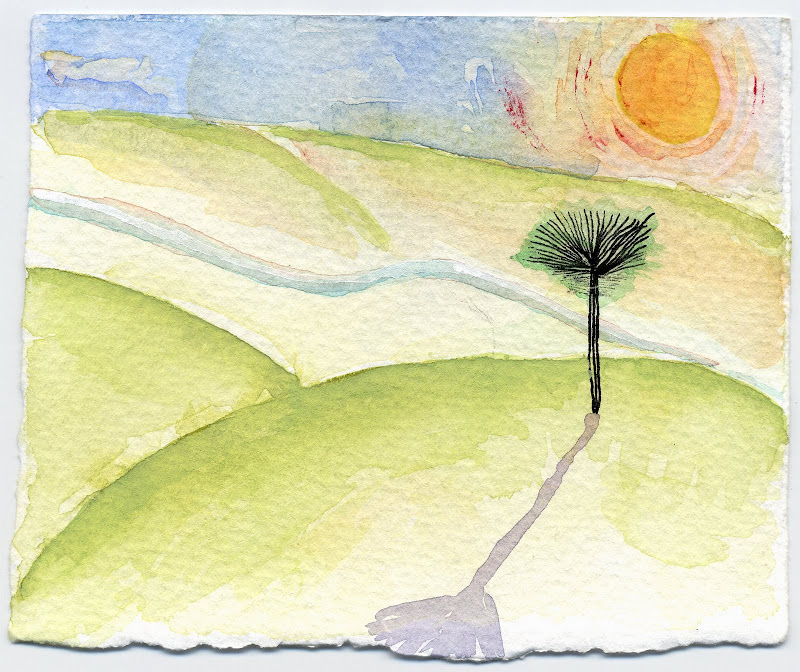+on+a+summer+day.jpg.jpg) [10] (This small tree will grow to provide shade for all who need it.) Throughout my life, on whatever path I may take, I will share my enthusiasm for life and genuine concern for these children to inspire them to make it through whatever tough times they may be facing.
[10] (This small tree will grow to provide shade for all who need it.) Throughout my life, on whatever path I may take, I will share my enthusiasm for life and genuine concern for these children to inspire them to make it through whatever tough times they may be facing.Word Count: 1649
[1] The Scent of Water, http://scentofwater.wordpress.com/2007/11/15/five-favourite-photographs-theoretically-speaking/ (accessed February 19, 2008).
[2] Presentation Helper http://images.google.com/imgres?imgurl=http://www.presentationhelper.co.uk/Images/farewelleulogy.jpg&imgrefurl=http://www.presentationhelper.co.uk/funeral_farewell_poem.htm&h=200&w=234&sz=5&hl=en&start=2&um=1&tbnid=Uk0QHMElAwmBfM:&tbnh=93&tbnw=109&prev=/images%3Fq%3Dfuneral%2Bspeech%26um%3D1%26hl%3Den%26client%3Dsafari%26rls%3Den-us%26sa%3DG (accessed February 19, 2008).
[3] Jupiter Images, http://images.google.com/imgres?imgurl=http://images.jupiterimages.com/common/detail/85/92/23469285.jpg&imgrefurl=http://www.jupiterimages.com/itemDetail.aspx%3FitemID%3D23469285&h=250&w=177&sz=21&hl=en&start=3&um=1&tbnid=zJDtDKQsrXIp0M:&tbnh=111&tbnw=79&prev=/images%3Fq%3Dold%2Blady%2Breading%2Bto%2Bchildren%26um%3D1%26hl%3Den%26client%3Dsafari%26rls%3Den-us%26sa%3DG (accessed February 19, 2008).
[4] The Scottish Government, http://images.google.com/imgres?imgurl=http://www.scotland.gov.uk/Resource/Img/54357/0009794.jpg&imgrefurl=http://www.scotland.gov.uk/Publications/2005/06/09105814&h=184&w=200&sz=6&hl=en&start=21&um=1&tbnid=Cgq6tguylCEuLM:&tbnh=96&tbnw=104&prev=/images%3Fq%3DPrader%2BWilli%2Bsyndrome%26start%3D20%26ndsp%3D20%26um%3D1%26hl%3Den%26client%3Dsafari%26rls%3Den-us%26sa%3DN (accessed February 19, 2008).
[5] John Gray, Children are from Heaven (New York: Mars Productions, 1999), 223.
[6] Farrington Welsh, Saving Children from a Life of Crime (New York: Oxford University Press, 2007), 4.
[7] Seamus Carey, The Whole Child: Restoring Wonder to the Art of Parenting (Maryland: Rowman and Littlefield Publishers, 2003), 100.
[8] Children Quotes, http://www.wisdomquotes.com/cat_children.html (accessed February 19, 2008).
[9] John Gray, Children are from Heaven (New York: Mars Productions, 1999), 289.
[10] Picasa Web, http://picasaweb.google.com/samueloverington/LonelyTree/photo#5057144196734551682 (accessed February 19, 2008).
